EFA Opening: „Europe wins when we act together“
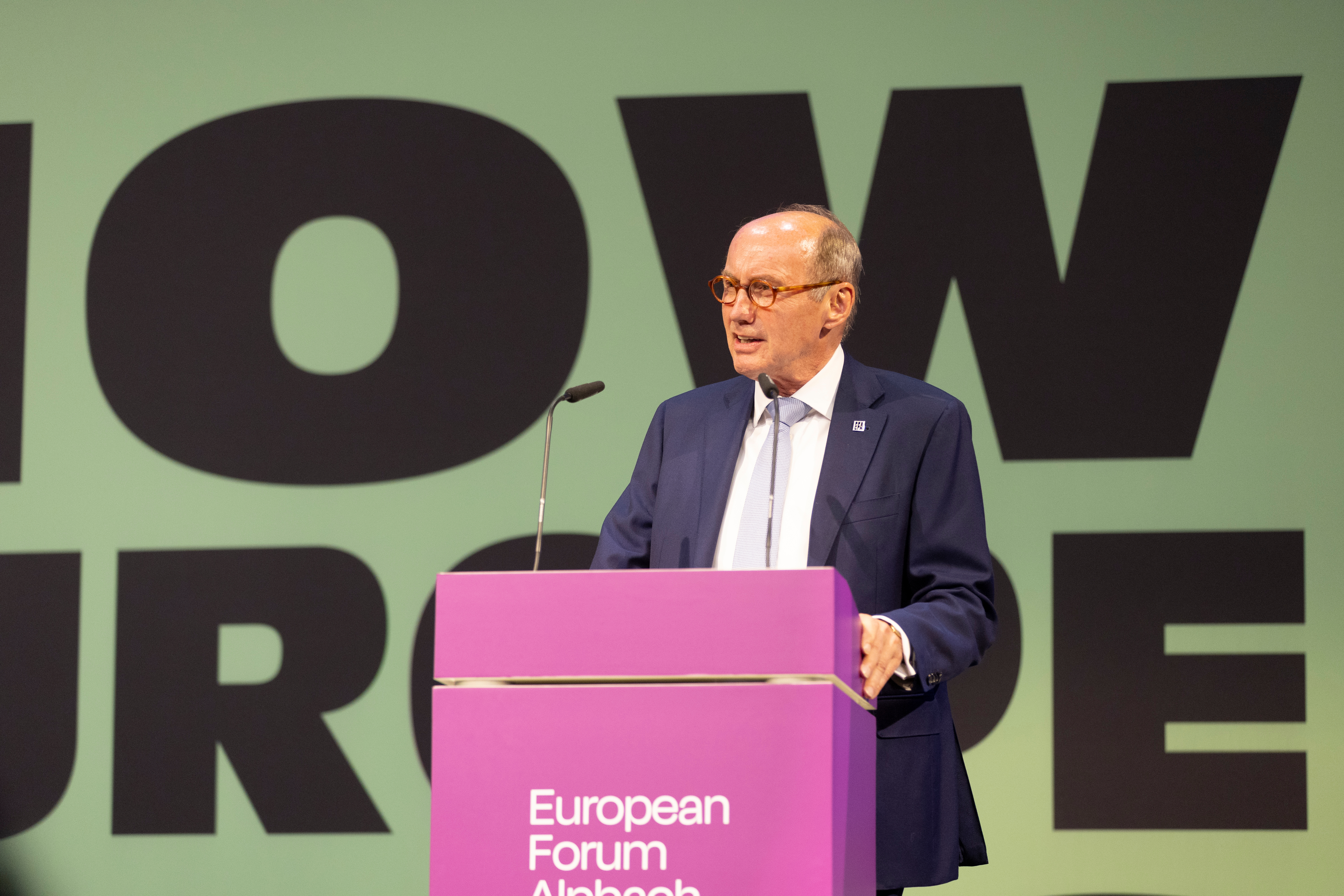
Excellencies, Ladies and Gentlemen, distinguished guests, and especially: dear Scholarship Holders,
welcome to Alpbach. And welcome to the Conference Days of the European Forum Alpbach 2026.
This year we did not give ourselves a slogan. We gave ourselves a task: How Europe Wins. Not a question. Not a hope. Not a headline. A sentence that only becomes true if we do something about it.
In 1945, this village hosted the first European university weeks. Our continent was destroyed. People came to Alpbach because the farmers of this valley fed them. They had no money. They had no institutions. Many of them had lost everything.
What they brought was hope, a promise, and a decision. The hope was that the future could be better than the past. The promise was: never again. And the decision was to learn from painful experience, together, across borders and across parties.
Eighty-one years later, with all the highs, the lows and the mistakes, this is a success story. And this is the first thing I mean by winning: Europe wins when it learns from experience.
Many people today think all of our democratic achievements are normal. As if they were given. As if peace, freedom and the single market were part of the weather. I call them the sleepwalkers. I borrow that word from Christopher Clark and his book, from how he describes the leaders of 1914. They were not uninformed. They simply did not draw the consequences from what they saw.
The sleepwalkers today are not the extremists. They are people in the middle, in politics, in business, in the media, who see what is happening and still believe that it will pass. They believe that when Trump loses the midterm elections, when Putin agrees to a ceasefire and simply keeps the land he took, then everything will go back to how it was.
For example for the people of Ukraine, nothing will be as it used to be. The people of Ukraine are not only defending their country. For years now, they have been defending all the values and principles that the EFA and the European Union stand for.
And despite all this, some sleepwalkers say it out loud: give the nationalists a chance, let them lead governments, they will fail, and then we are back.
These sleepwalkers have to understand: There is no way back to before. What we are living through is not a bad season. It is a fight about who is allowed to break the rules, instead of rules that hold for everyone.
Helmut Kohl, in his last essay, written out of concern for Europe, asked: „Have we all gone mad? Have we forgotten where we come from?“ I do not read that question as a memory. I read it as a task for us, here, this week.
Now why are so many people asleep? I think there is an honest answer: A democracy stays strong as long as it can keep one promise: that tomorrow can be better than today. When that promise becomes uncertain, people do not become extremists overnight. First they become tired. Then they become angry. Then they stop listening.
I met a lot of people this summer. Entrepreneurs, researchers, employees, pensioners, students. They told me about the rules that do not fit, the decisions that take too long, the projects that never arrive. They shake their heads about Trump and Putin, about the poll numbers of the extreme right. Almost every one of them has a point.
But being right is not the same as being useful. Complaining does not lead us out of the valley. It hides our strengths. It hides our successes. It hides our chances. And it delivers, every single day, the raw material that the populists, the nationalists and the extremists need.
The extremes live from this mood. But let us be honest: the centre feeds it far too often. We feed it when we explain a decision only after we have taken it. We feed it when we blame Brussels for what we agreed to ourselves. We feed it when we copy the language of the extremes and hope that it makes us popular.
So this is my appeal, and I include myself: Let us stop complaining. Let us stop blaming. Let us stop making ourselves small. Let us stop the excuses for why something cannot be done.
People want leadership. That wish is legitimate. Today it is offered by the loudest voices and the simplest answers. „I will end the war“, says Donald Trump. „We will not accept a single asylum application any more“, says Herbert Kickl. Sentences like these – sadly – win the moment. They never become reality.
The democratic centre has to fill this need for leadership differently. Not volume, but results. Not slogans, but delivery. Not announcements, but implementation. Not withdrawal, but participation, reasons and debate.
And we can do this. Because we already know what to do. That is the encouraging part of this evening, and also the painful part. The „to dos“ have been on the table for years. They are not new and not a secret. And still, we fail to deliver.
Let me just give you three short examples.
First: We divide what should be one market. Our single market has 450 million citizens. With the candidate countries it could serve more than 600 million. And yesterday the people of Iceland voted to reopen their talks with us. While we doubt ourselves, others want to come in. That should tell us something about our own strength. But still, a company that wants to sell in Europe has to think in 27 versions of the same rule.
Second: We save our money and then send it abroad. Around 33 trillion euro of private savings sit in bank deposits in Europe. Roughly 300 billion of it flows into the American economy every year. Our money builds someone else’s future. And then we wonder why our best companies grow up somewhere else.
Third: We add rules instead of agreeing on one rule for all. We agree something in Europe, and then we make it even harder at home. National governments add their own layers on top, invent their own exceptions, and afterwards they call the result Brussels bureaucracy.
I am therefore delighted that Enrico Letta – Mr. Single Market – is with us today to open the Conference Days. No one could explain better how the gap between analysis and action can be bridged. Thank you, Enrico, for being here with us today.
Jean-Claude Juncker once described our problem better than anyone: „We all know what to do. We just don’t know how to get re-elected after we have done it.“ That sentence is honest. But it cannot be our excuse. So the question tonight is not what should be done. The question is why we still have not done it.
Let me come back to our task. When we say How Europe Wins, we do not mean winning in the usual sense. We do not mean winning against someone. Working together makes us able to act. It makes us faster, better and cheaper. Working together is what makes us sovereign. Without it we lose. So the answer is simple: Europe wins when Europe acts together.
And this brings me to the last thought I want to leave with you today. In 1953, Winston Churchill was asked how one should prepare for the responsibility of leading a state. His answer was short: „Study history. Study history. In history lie all the secrets of statecraft.“
I have come to believe that we did not follow that advice well enough. At best, some of us have a feeling for western European history, and others for eastern European history. A shared one? For most people, the national border is still the horizon. And that is one of the real reasons why we misunderstand each other, and why we blame each other so easily.
A Union of this continent will only exist if we know about each other. About the different paths, the open wounds, the cultures, the religions, the crises that were survived, and about the words that mean something different in Warsaw than they do in Vienna or in Lisbon.
That is what these days are for. In Alpbach we want to get to know each other. To talk with each other. And to learn from each other. So take part. Listen. Disagree. Argue. Talk to the people you did not come here with.
Because with the European Forum Alpbach it is like with democracy, and like with the European Union: it becomes what we make of it.
Thank you very much.